Sanki Bir Başı Yok
Sanki Sonu da Olmayabilir
As If It Has No Start and Might Not Have an End
Gülcan Evrenos, Mart 2021
Ütopik Bürokratik sergi kataloğu
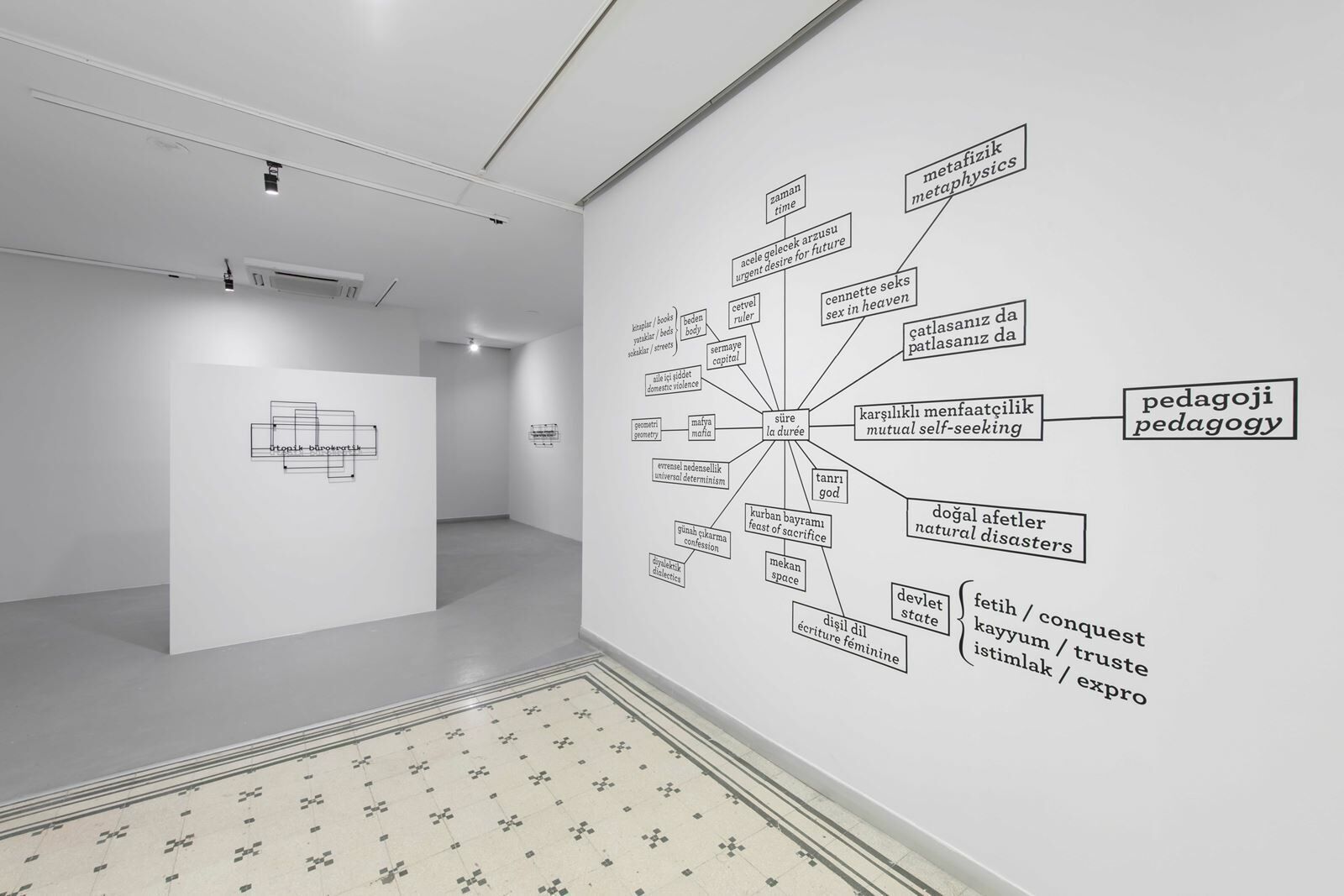
Abdülhak Şinasi Hisar’ın Boğaziçi Mehtapları’nı okurken tesadüfen Hélène Cixous’nun dert ettiği dişil dil söylemiyle de tanıştım. Dil böyle olduğu sürece hiçbir şey değişemez demeye getiriyordu Hélène. Feminizmin Lacan’ıydı bir nevi. Bilinçdışının dil gibi örgütlenmiş oluşu kilitti. Dil düzelmeden hiçbir şey düzelmezdi. Öyle doğru ki, baktıkça daha çok görüyordum. Dişi değil dişil dil nerede olabilir diye o arayadursun ben bu dili Abdülhak Şinasi Hisar’ın metinlerinde buldum.
Burada cinsiyetlerden öte bir bağlamdan bahsetmek isterim. Dilin genel yapılanması gerçekten de erkek beyninin işleyişiyle örtüşen bir mekanik barındırıyor. Mektedir, maktadır, bu budur, şu şudur, yüklü yüklemler ve nokta. Süreç değil sonuç beklentisi. Bir nokta sevdası. Bunu sadece Türkçede de görmüyorum. Bilip izleyebildiğim diller, erkek fizyolojisinin düşüncelerden cümlelere ve kurguya dönüşmüş hali gibi. Derdimi anlattım, konuyu kapattım. Görevim var, ifa ettim. Elbette ifade edip rahatlayalım ama bu keskinlik şart mı?
Küçük yaşından itibaren kadınlarla beraber büyümesinden mi, divan edebiyatının eda üzerine kurulu efsunlu dünyasından gelmesinden mi bilemiyorum ama Hisar’ın metinleri dişillikleriyle ışıldıyor. Bir ferah su gibi üzerimize dökülüyor. Ferahlatıyor, büyülüyor. Sarıyor ama düğümlemiyor. Bir parçası her yerine ilişkin. Tek cümleyi seçsen hepsi peşinden gelecek gibi. Ne anlatıyor desek birileri belki sadece üç cümleye sokar. Ama bu o dil değil. İnsan istiyor ki hiç bitmesin. Sanki bir başı yok, sanki sonu da olmayabilir. Bu metin kelimelerle çalınan bir müziğe benziyor. Uzuyor uzasın hiç bitmesin dercesine. Her bir kelime nasıl zarafetle seçilmiş, aynı kelimeler nasıl bu kadar başka cümleler kurabilmiş insan durup bir daha bakıyor. Bu tam Hélène’in bulmak isteyeceği bir metin. Benim kendi dilim pek dişil sayılmaz o yüzden bir son yazacağım.
Dile dışardan bakmak bile ne harika. Ya da başka bir akstan demeliyiz belki de. İnsan yerini, yurdunu, evini ancak böyle bulabilir.
While I was reading Abdülhak Şinasi Hisar’s Moonlight on the Bosphorus, I accidentally met the feminine language discourse that Hélène Cixous had troubled herself with. Hélène meant that nothing could change as long as the language was like that. She was, in a way, the Lacan of feminism. The key was that the unconscious was organized like language. Nothing would improve unless the language improved. It is so true; the more I looked, the more I saw. Whereas she was searching for where the feminine language, not the female, can be, I found this language in the texts of Abdülhak Şinasi Hisar.
Here I would like to talk about a context beyond the genders. The general structuring of language, indeed, contains a mechanic that coincides with the functioning of the male brain. This is that, that is this, loaded predicates and full stop. Expectation of results, not processes. Loving full stops. I don’t see this only in Turkish. Languages that I can speak and trace are like the transformation of male physiology through thoughts to sentences and fiction. I explained my problem, the case is closed. I have a duty, I fulfilled it. Sure, let’s express ourselves and relax, but is this sharpness a must?
I do not know if it is because he grew up with women from a young age, or because he came from the enchanted world of divan literature based on attitude, Hisar’s texts shine with their femininity. They pour over us like fresh water. Refreshing and fascinating. It wraps but does not knot. Every part is about the whole. If you choose one sentence, it is as if all others will come at you. If we ask what he is talking about, someone may put it in only three sentences. But this is not that language. You want it to never end. It doesn’t seem to have a start, and it might not have an end, as well. This text looks like music played with words. It stretches and stretches as if it will never end. How gracefully each word was chosen, how the same words were able to form so many different sentences, you stop and look back one more time. This is exactly the text that Hélène would love to find. My own language is not quite feminine so I’ll write a closing remark.
How wonderful to even look at the language from the outside. Or maybe we should say from another axis. This is the only way one can find the place and home of their own.