Bürokrasi Bürokrasiyi Doğurur:
Memed Erdener’in
Cesur Yeni Dünya’sı
Bureaucracy Begets Bureaucracy:
Brave New World by
Memed Erdener
Marta Smolińska, Şubat 2021
Ütopik Bürokratik sergi kataloğu
Kuralların Ütopyası (2015) kitabının yazarı Amerikalı antropolog David Graeber’e göre, çağdaş dönem, kamu bürokrasisiyle özel bürokrasinin birbirinden doğru düzgün ayırt edilemediği tam bir bürokratikleşme çağı olarak tanımlanabilir. Bu bürokrasiler kapitalizmin ana mekanizmaları haline gelmiş olup şiddet tehdidini (yargı ve polis yoluyla) birçok ülkede gündelik yaşamın hemen her alanına taşımıştır. Toplumda görülen kitlesel örgütlenme biçimlerinin neredeyse hiçbiri bürokratik eğilime karşı koyamamıştır. Graeber ayrıca insanların bürokrasilerle nasıl ilişki kurduğu ve onlardan nasıl etkilendiğiyle ilgili çok genel bir soru da sormuştur. Bürokrasinin getirdiği “düzen ve düzenliliğin” yarar sağlamaktan ziyade zarar verdiğini ve “insanın hayal gücünün ezilip paramparça edildiği araçlara” benzediğini vurgulamıştır. Bu bakış açısına göre, bürokrasiler artık Franz Kafka’nın Kale’sinde olduğu kadar zekice incelenip hicvedilmemektedir. Sonuç olarak Graeber kitabında, yaratıcılığı engelleyen ve yok eden bürokratik engelleri ortadan kaldırmak için acil bir çağrıda bulunur.
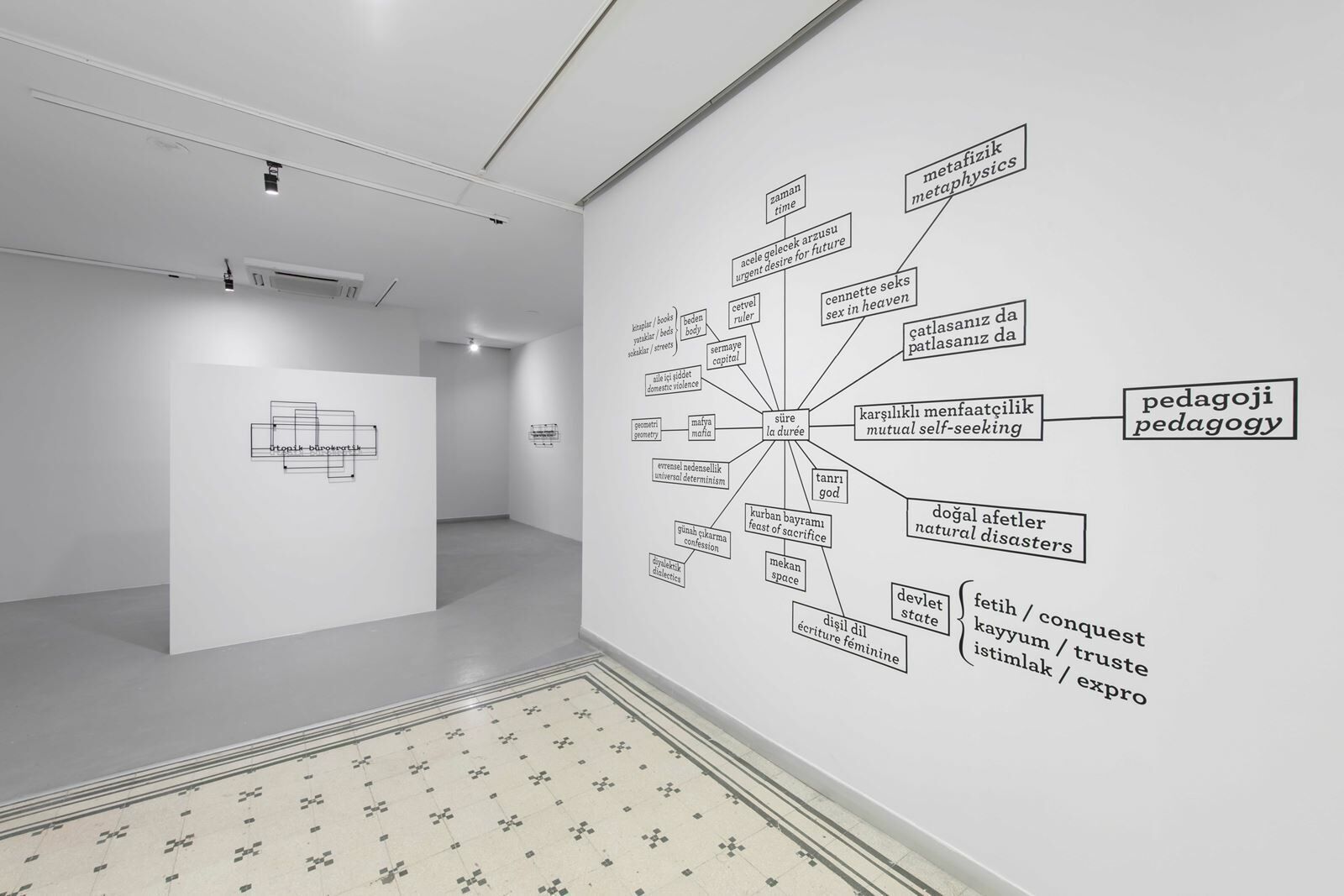
Bürokrasilerin sadece gündelik yaşamı değil, aynı zamanda insanın hayal gücünü ve insanlık durumunu nasıl yapılandırabileceği bakımından, Türk sanatçı Memed Erdener’in düşüncelerini incelemek ve çerçevelendirmek için Graeber’in teorisini kullanacağım. Erdener Zilberman İstanbul’da gösterilen kişisel sergisi  Ütopik Bürokratik’te, ütopik bürokrasi fikrine bağlı kurumların başat rol oynadığı “gelecekte bir ülke için fikirler” geliştiriyor. Söz konusu ülkede zaman ve mekan, beden ve devlet, geometri ve pedagoji ve son olarak bu ütopik bürokratik sistemin felsefi çerçevesini sunmak üzere diyalektik ve metafizik gibi sekiz tipik çalışma alanı bulunuyor. Memed Erdener’in hayal ettiği ülke olan “İnsan ve Doğa Ülkesi” için aslında son derece post-antroposentrik diyebilirim. Bu ülkedeki belirli bakanlıkların isimlerini okuduğumuzda, kimsenin dışlanmadığını söyleyebiliriz. Aksine insanlar ve insan dışılar, yani bitki ve hayvan gibi varlıklar ve hatta “şeyler” bile mutlu olmalıdır (“Mutluluğu Gelecekten Şimdiye Taşıma Bakanlığı”), bunların hiçbiri geçmişin travmasına uğramamalı, (“Geçmişle Barışma Dairesi”) iyi ve ekolojik bir eğitimden geçmelidir (“Tabiattan Öğrenme Ocakları”). Sanatçı, “Bu kurumlar diyalektik veya metafizik düzenlemeleri meydana getirecek devlet kurumlarıdır. Bu kurumlar beden ve toplum üzerinde çalışacaktır. Bu kurumlar zaman ve mekan odaklı düşünebilecektir. Bu kurumlar geometrik ve pedagojik operasyonlar yapabilen ütopik devlet daireleridir,” der. Sanatçının saydığı ihtimaller kulağa son derece iyimser ve umut verici gelse de, mükemmel düşünen ve çalışan bu kurumları hayalde canlandırmanın bile korkutucu bir yanı vardır, öyle değil mi? Vatandaşlar hakikaten korkudan, baskıdan, şiddetten ve ıstıraptan kurtulacak mıdır? Beden ve devletin yan yana gelmesi, ülkenin devasa bürokratik makinesi karşısında bireyin ne kadar küçük olduğunu gösterir; bu ülke “İnsan ve Tabiat Ülkesi” olsa bile. İnsan bedeni üzerinde tasarrufta bulunan devletin eylemlerinde meşruiyet sınırı nerede çizilir? Beden üzerindeki mahrem seçimlere yönelik hangi kamusal müdahaleler haklı görülebilir? Korumakla zarar vermek birbirinden nasıl ayırt edilir? Memed Erdener’in hayal gücünde idealleştirdiği bu ülke baştan çıkarıcı olduğu gibi korkutucudur da; tıpkı tarihte insanlığın yarattığı tüm ütopik fikirler gibi. Şairlerin, filozofların, sosyal reformcuların, mimarların, sanatçıların ve daha nicelerinin en ince detaylarına kadar düşündüğü birçok ütopya bulunmaktadır. Gregory Claeys, “Ütopya hayal görmeyi, ümit etmeyi ve kafa yormayı bırakıp dünyanın kendi görüntüsünde yeniden yaratılmasını talep ettiğinde pratiğe dökülür,”1 demiştir. Bu talebin ortaya çıkış ânı çoğu zaman için fazlasıyla tehlikelidir, çünkü ütopik amaçlar ideolojilerle güçlü bir şekilde bağlantılı olup neredeyse her zaman distopyaya götürür. Birçok düşünür ütopyadan totalitarizme giden yörüngeyi ve işin içine mutlaka şiddetin girdiğini görmüştür.
Söz gelimi “Unutulması Gerekenleri Belirleme Şubesi” için kim çalışacaktır? Bu zorunlu unutma sürecinde kimlerin hakkı ihlal edilecektir? Ütopik olan bu örnek de dahil olmak üzere bürokrasi her zaman son derece insanlık dışı, gayri şahsi ve bireysizleştirilmiş mahiyettedir. Kolektif hafıza ve kültürel hafıza tarafından şekillendirildiği durumlarda bile, hafıza son derece tekil ve kişisel bir şey gibi görünmektedir. Özellikle bilinçlice inşa edilmiş ve hatta sansürlenmiş bir tarih anlatısıyla oluşturulan ütopik bir ülke mevzubahis ise, hafıza ve unutkanlık arasındaki bağlantı daha da hassas bir konu olarak karşımıza çıkar.
“Mağdur Hakları Bakanlığı” bünyesinde yer alan “LGBT Hakları Konseyi,” heteroseksüel olmayan ve doğumda kendisine atanan cinsiyeti taşımayan azınlıklarla ilgilenmektedir. Fakat aynı zamanda, “Ulus Değil Birey Bakanlığı”ndaki tekdüze ve türdeş oluşumların ortadan kaldırılmasından kim sorumludur, diye de sorabiliriz. Hangi oluşumların tekdüze ve türdeş olarak algılanması gerektiğine kim karar veriyor? LGBT azınlıklara bu özellikleri atfetmek mümkün müdür?
Bu gibi şüpheler ve sorular Memed Erdener’in Ütopik Bürokratik’in yapısını ne kadar yıkıcı bir şekilde inşa ettiğini göstermektedir. İlk bakışta, insanların eşit ve mutlu olduğu ama Aldous Huxley’in 1931’de yazdığı o meşhur distopik bilim kurgu romanda olduğu gibi, güzel kuralların pratikte pek o kadar geçerli olmadığı, cesur yeni bir dünyanın vaadi gibi görünüyor. Ütopyalara isyan eden Huxley istihbarat temelli toplumsal bir hiyerarşi içine çekilen vatandaşların özgürlüğü için ütopyaların ne kadar tehlikeli olabileceğini alaycı bir dille göstermiştir. Memed Erdener de, benzer şekilde, günümüzde son derece yaygınlaşmış, aşikarlık kazandığı için ise pek çok insanın nazarından kaçan, bürokrasinin özel bir türü olan ütopik bürokrasiye itiraz etmektedir. Sanatçının bu projesi gündelik yaşantımızın arka planında durmaksızın işleyen ütopik bürokratik stratejilerin varlığından haberdar olmamızı sağlıyor. “İnsan ve Tabiat Ülkesi”nin kurumları ve ütopik devlet daireleri, ülkenin eksik potansiyelini bulmak için geçmişi iyileştirmeye ve düzeltmeye bile çalışıyor.
Memed Erdener gücün merkezde toplandığı yönetim mekanizmasını gözler önüne sermek için bilinçli olarak bürokrasi stratejisini ve özel dilini benimsiyor. Çağdaş bürokrasinin hiyerarşi, süreklilik, kişiliksizlik ve uzmanlık olmak üzere dört özellikten oluştuğu bilinmektedir. Sanatçı kendi mükemmel ülkesini modellemek için bütün bu özellikleri devralmış görünüyor. Propagandanın sinsi retoriğiyle alaycı bir şekilde oynuyor; bize birçok abartılı bilgi veriyor, ya da sadece tek taraflı hikayeler anlatıyor. Belirli bakanlıkların isimleri bize, insanları baştan çıkarmak, ikna etmek ve en nihayetinde toplum içindeki davranışlarını manipüle etmek için kullanılan retorik yanlışlıkların çok özel bir kullanımını hatırlatıyor. “Bireyler Meclisi” ve “Aşk ve Matematik Danışma Konseyi” fikrine ilk bakışta aşık oluyoruz, öyle değil mi? Halbuki “Sevgi Bakanlığı” ve “Hakikat Bakanlığı”nı George Orwell’in Bin Dokuz Yüz Seksen Dört romanından zaten biliyoruz. Memed Erdener bu sergide böyle bir retoriğin etik açıdan tarafsız ve suçsuz olmadığını söyler gibidir. Bunların tümü birer algı şekillendirme, bilişselliği manipüle etme ve davranışları yönlendirme girişimidir. Ütopik bir bürokrasinin dili ve onun mekanizmalarını kullanan propaganda retoriği şeffaf değildir. Bilgi üretir ve bilgiyi aktarmanın çeşitli yollarını denetim altında tutar. Memed Erdener’in konseptiyle karşılaştığımız bakanlıkların, komitelerin, birimlerin, konseylerin, denetim kurullarının, derneklerin ve odaların isimlerinin yer aldığı, hava limanı gibi kamuya açık alanlarda yer almak üzere tasarlanmış tabelalara baktığımızda bu iletişim biçiminin güçlü etkisi daha da belirginleşiyor. “İnsan ve Tabiat Ülkesi”ne varır varmaz, insanlar ütopik bürokrasinin ve propagandanın etkisi altına girmeye başlıyor.
Dolayısıyla Ütopik Bürokratik projesi Kuralların Ütopyası kitabının yazarı David Graeber’in arzu ettiği biçimde, bir yandan bürokratik sınırların kaldırılması gerektiği yönündeki acil çağrıya bir yanıt olarak, diğer yandan ise mevcut bürokrasilerin alaycı bir analizi olarak yorumlanabilir. Memed Erdener’in kavramsal olarak yarattığı cesur yeni ülke çağdaş Türkiye için geçerli olsa da, ben bu ülkeyi evrensel olarak değerlendiriyorum, çünkü hükümetin güç kullanma politikalarından, bürokrasiden ve propagandadan dünyanın her yerinde herkes kişisel düzeyde etkilenmektedir. Örneğin Polonyalı olarak ben, ütopik bürokratik bu kurumların her birini Polonya için pekâlâ hayal edebiliyorum. İşin gerçeği, bu kurumları her yerde hayal edebiliyorum.
Sonuç olarak, Memed Erdener’in yıkıcı projesi Ütopik Bürokratik bir tür kısır döngüye kapıldığımızı göstermektedir. David Graeber’in kitabını değerlendiren Cory Doctorow’un da dediği gibi, “Bürokrasi yaygındır ve metastatiktir. (…) Bürokrasi ütopik bir projedir. Tüm ütopyacılar gibi kapitalist bürokratlar (ister özel sektörde ister kamu sektöründe olsun) insan davranışlarının bir ideale göre değiştirilerek mükemmelleştirilebileceğine inanırlar ve bu ideale göre yaşayamayan herkesi suçlarlar. (…) Bürokrasiyi ortadan kaldırmaya yönelik her çaba, daha fazla bürokrasiyle sonuçlanır. Bürokrasi yalan söylemektedir.”2 Her şeyin bürokratikleştiği bir çağın tanığı olan Memed Erdener’in siyasi içerikli ironik sanat projesi, bir türlü kopamadığımız bürokratik sistemin bir parçası olduğumuzun, ütopya hayalleri kurduğumuzun farkına varmamızı sağlar. Bürokrasi bürokrasiyi doğurur ve ütopyalar distopya olur. Orwell’in distopik görüşüne göre, adına “Sevgi Bakanlığı” denen korkunç yerde hiç pencere yoktu.
Referanslar
1 Gregory Claeys, Searching for Utopia: The History of an Idea, Londra 2011, s. 99.
2 Cory Doctorow, “David Graeber’s The Utopia of Rules: On Technology, Stupidity, and the Secret Joys of Bureaucracy” Boing Boing. [çevrimiçi] https://boingboing.net/2015/02/02/david-graebers-the-utopia-of.html [erişim tarihi: 03.02.2021].
According to an American anthropologist David Graeber, the author of the book “The Utopia of Rules: On Technology, Stupidity, and the Secret Joys of Bureaucracy” (2015), the contemporary era could be described as an age of total bureaucratisation, in which public and private bureaucracies cannot be effectively distinguished from one another. These bureaucracies have become the main mechanisms for capitalism and brought the threat of violence (through juridical and police enforcement) into almost every aspect of daily life in many countries. Almost no form of the mass organization of society has been able to withstand a bureaucratic trend. Graeber poses also a very general question about how people relate to and are influenced by bureaucracies. He underlines that the “order and regularity” of bureaucracy is much more harmful than valuable and is more akin to “instruments through which the human imagination is smashed and shattered”. From his point of view bureaucracies are no longer analyzed or satirized as they brilliantly were in Franz Kafka‘s “The Castle”. In his book, Graeber consequently makes an urgent call to remove the bureaucratic limits that destroy and hamper creativity.
I would extend the theory of Graeber to examine and frame the idea of Turkish artist Memed Erdener from the perspective of how bureaucracies can structure not only the everyday life, but also human imagination and human condition. His project “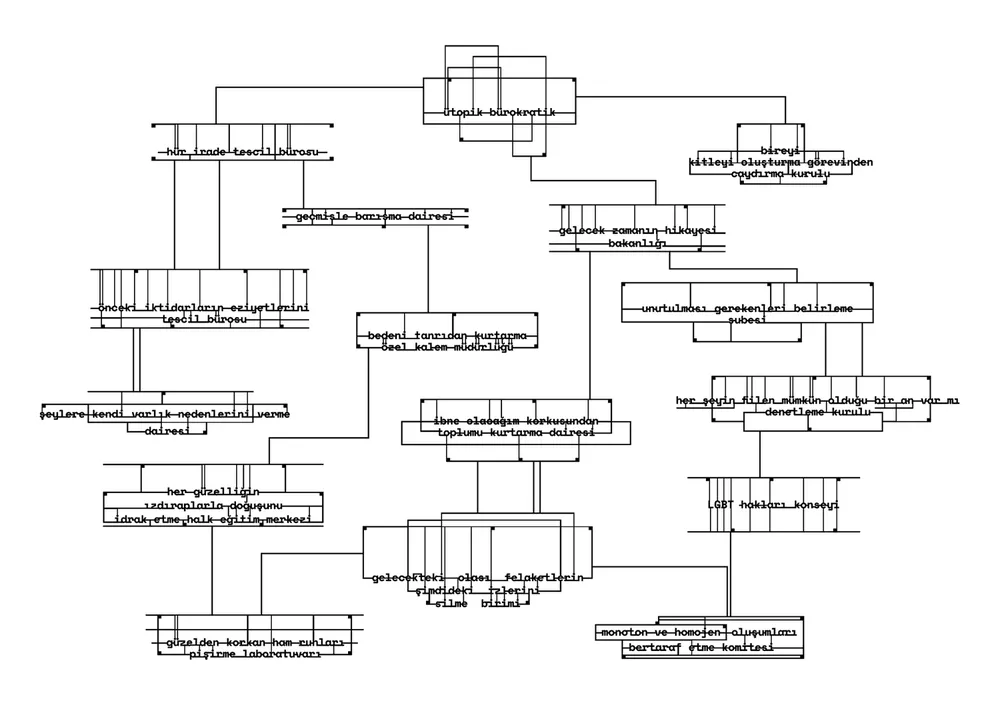 Utopian Bureaucratic”, prepared specifically for his solo exhibition at the Zilberman Gallery in Istanbul, develops some “ideas for a country in the future”, where the most important role is played by institutions connected to the idea of a utopian bureaucracy. There are eight working areas which are typical for this kind of bureaucracy: time and space, body and state, geometry and pedagogy, and last but not least dialectics and metaphysics as the philosophical frames for this utopian bureaucratic system. The country imagined by Memed Erdener is called “Country of Human and the Nature” – actually, very postanthropocentric, I would say. When we read the names of the particular ministries in this country, we can say that nobody is excluded; on the contrary, everyone – human beings and non-human beings like plants, animals and even things – should be happy (“The Ministry of Shifting Happiness Back from the Future to Now”), not traumatized by the past (“Chamber of Making Peace with the Past”) and well and ecologically educated (“Society for Learning from the Nature”). The artist underlines: “These institutions are state institutions that will bring about dialectical or metaphysical regulations. These institutions will work on the body and society. These institutions will be able to think in a time and space oriented manner. These institutions are utopian government offices that can have geometric and pedagogical operations.“ The prospect might sound very optimistic and promising, but there is also something frightening in the imagination of these perfectly thinking and working institutions, isn’t there? Are the citizens really enjoying freedom from fear, oppression, violence and suffering? The juxstaposition of body and state shows how small an individual is when confronting the gigantic bureaucratic machine of the country – even if it is “Country of Human and the Nature”. Where are the limits of the legitimate role of the state in regulating the human body? Which public interventions into private choices over the body could be justified? How to differentiate protection from harm? The ideal imagination of this country, proposed by Memed Erdener, is seductive and fearsome at the same time – like all utopian ideas which have been created by humankind in history. Utopias have been imagined in intricate details by, among others, poets, philosophers, social reformers, architects and artists. According to Gregory Claeys: “Utopia becomes practical when it ceases to dream, to hope and speculate and demands that the world be remade in its own image”1. The moment that this demand comes to life is usually very dangerous, because utopian aims almost always lead to dystopia and are strongly connected with ideologies. Many thinkers see very clearly a trajectory from utopia to totalitarianism, with violence being an inevitable part of the mix.
Who would work for “Unit of Determining What Needs to Be Forgotten“? Who could be violated in this process of obligatory forgetting? The Bereaucracy, even this utopian one, is always very inhuman, impersonal and deindividualised. On the contrary, memory seems to be very individualised and personal, even though it is shaped by collective and cultural memory. The connection between memory and forgetfulness is a very sensitive subject, especially in the frame of a utopian country which is constituted by a consciously constructed or even censored version of history.
“LGBT Rights Board“ as a part of “Ministry of Victim Rights” takes cares of the minorities of non-heterosexual and non-cisgender people. But at the same time, we can ask, who is responsible for eliminating monotonous and homogenous formations in the “Ministry for Individuals Not for the Nation“? Who decides which formations should be perceived as monotonous and homogenous? Could the LGBT-minorities be described with these features?
These doubts and questions underline how subversivly Memed Erdener has constructed the structure of his “Utopian Bureaucratic”. At the first sight, it looks like a promise of a brave new world, where people are equal and happy but – like in the famous dystopian science fiction novel by Aldous Huxley, written in 1931 – the beautiful rules do not apply equally in practice. Huxley was revolting against utopias showing in an sardonic way how dangerous it can be for the freedom of citizens, who are environmentally interpellated into an intelligence-based social hierarchy. Memed Erdener is revolting against the special type of utopia, a bureaucratic one, which is so common in our times that it has become so obvious for many people that it is imperceptible. The project of the artist makes us aware of the presence of the utopian bureaucratic strategies which are constantly working in the background of our daily life. The institutions and utopian government offices of “Country of Human and the Nature” even try to improve and correct the past to find its incomplete potential.
Memed Erdener consciously adopts the strategy and the specific language of bureaucracy in his project to reveal the mechanism of a centralized form of management. The contemporary bureaucracy has been defined as comprising four features: hierarchy, continuity, impersonality, and expertise. All these features seem to have been taken over by the artist to model his perfect country. He mockingly plays with the sneaky rhetoric of propaganda, giving us a lot of exaggerated information or only telling us one-sided stories. The names of the particular ministries remind us of a very special use of rhetorical fallacies which are used to seduce, convince and at last manipulate people, along with their social behaviors. At the first sight, we are in love with the idea of “Parliament of People” with “Advisory Council of Love and Mathematics”, aren’t we? However, we already know the “Ministry of Love” and the “Ministry of Truth” from George Orwell’s novel “Nineteen Eighty-Four”. This kind of rhetoric is not ethically neutral and „unguilty“ – Memed Erdener seems to say. It is an attempt to shape perceptions, manipulate cognitions and direct behaviors. The language of a utopian bureaucracy and the rhetoric of the propaganda using its mechanisms are not transparent. They are producing knowledge and controlling various ways of transmitting knowledge. The powerful impact of this form of communication becomes even much more obvious when we look at the spatially designed direction signs with the names of the ministries, committees, units, councils, supervisory boards, societies, commissaries and chambers, which we encounter – in accordance with the concept of Memed Erdener – in places such as airports. Once upon arriving in “Country of Human and the Nature”, people start being influenced by the utopian bureaucracy and propaganda.
Hence, on the one hand, the project “Utopian Bureaucratic” can be interpreted as an answer to this urgent call of David Graeber that bureaucratic limits should be removed, and, on the other hand, as a satirical and sardonic analysis of bureaucracies, which has been so intensively desired by the author of the book “The Utopia of Rules”. Although Memed Erdener has created his concept of a brave new country for contemporary Turkey, I would understand it as a universal one, because everybody is affected on a personal level by the government’s power politics, many types of bureaucracies and propaganda. I am Polish. I could imagine every one of these institutions of a utopian bureaucracy in Poland, too. Actually, I can imagine them everywhere.
Thus, the subversive project “Utopian Bureaucratic” of Memed Erdener shows us that we are caught in a kind of vicious cycle. In a review of David Graeber’s book, Cory Doctorow underlines: „Bureaucracy is pervasive and metastatic. (…) Bureaucracy is a utopian project: like all utopians, capitalist bureaucrats (whether in private- or public-sector) believe that humans can be perfected by modifying their behavior according to some ideal, and blame anyone who can‘t live up to that ideal for failing to do so. (…) Every effort to do away with bureaucracy ends up with more bureaucracy. Bureaucracy lies.”2 Memed Erdener is a witness of an age of total bureaucratisation and his politically engaged and ironic artistic project makes us aware that we, being a part of the bureaucratic system which we cannot leave, are fantasising about utopias. Bureaucracy begets bureaucracy, and utopias become dystopias… In the dystopian vision of Orwell, the “Ministry of Love” was the really frightening one, because there were no windows in it at all.
References